

Seville Cathedral: an essential visit in the historic heart of the city
The Seville Cathedral is one of Spain's great heritage landmarks and one of the most important visits for those who want to discover the city's history in depth. Its presence dominates the historic centre and forms part of the monumental ensemble that defines the most recognisable image of Seville.
Beyond its sheer grandeur, what makes this building so special is its ability to encapsulate centuries of urban, religious and artistic transformation. Visiting it is not simply about entering a monumental temple, but about exploring one of the places that best explains the historical evolution of Seville.
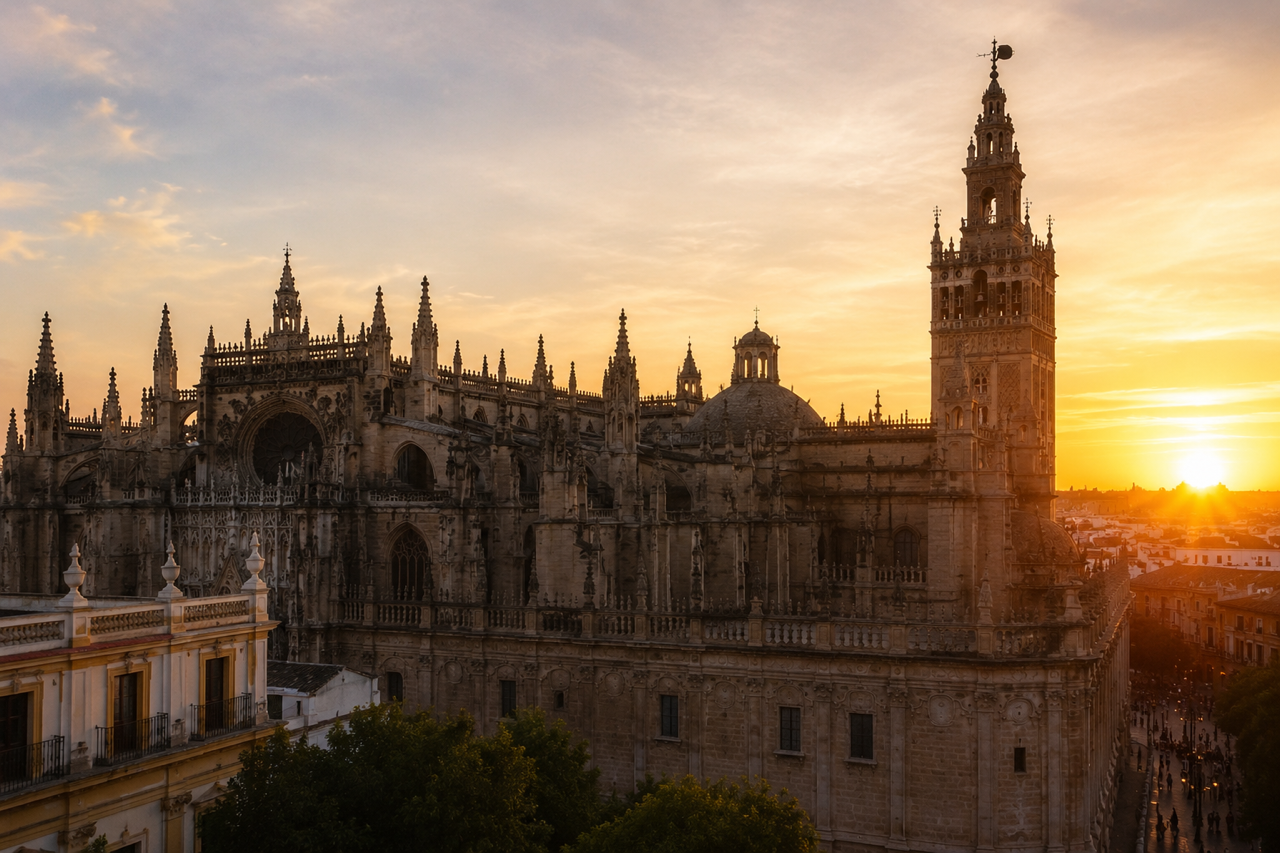
The origin of Seville Cathedral
The current Seville Cathedral was erected on the site of the former Great Mosque Almohad. After the Christian conquest of the city, this space was used as a cathedral until, with the passage of time, it was decided to build a new large temple.
The result was a monumental work that would eventually come to be recognised as the largest gothic temple in the world. This decision perfectly reflects the importance that Seville acquired in the late Middle Ages and early Modern Age, when the city consolidated its position as one of the great centres of southern Europe.
La Giralda: from minaret to symbol of Seville
One of the most admired elements of the ensemble is the The Giralda, which today serves as the bell tower of the cathedral, but which was originally the minaret of the old mosque. Its value lies not only in its beauty, but in everything it represents: it is one of the clearest examples of how Seville integrated its Islamic past into the Christian city.
Over time, his profile has become one of the great visual icons of Seville. In addition, the ascent to The Giralda is one of the most recommendable experiences of the visit, as it allows the visitor to contemplate the historical fabric of the city from above and to better understand the relationship between the cathedral, the old town and some of the most emblematic points of the city centre.
The Patio de los Naranjos and the Andalusi legacy
Another of the fundamental areas of the route is the Orange Tree Courtyard, This is one of the clearest vestiges of the Islamic period in the complex. It was formerly part of the mosque and over time retained its function as a place of transition and seclusion.
Today it is still a very special place, both for its historical value and for the atmosphere it offers within the monumental complex. In contrast to the monumentality of the interior, here everything is perceived in a more serene way. It is a corner that invites you to pause and helps you to understand that the Seville Cathedral was not built from scratch, but on an architectural and cultural memory that is still present today.
The interior: art, scale and monumental treasures
If the exterior is impressive, the interior of Seville Cathedral fully confirms the scale of the building. Its naves, soaring ceilings and overall spaciousness create a sense of grandeur that is difficult to compare with other churches.
Among its main attractions is the High Altarpiece, The church is one of the most outstanding pieces of Spanish religious art, both for its size and its visual richness. In addition to this, there are numerous chapels, grilles, funerary spaces and works of art that make the visit a much broader experience than that of a simple religious temple.
The cathedral functions almost like a vast artistic and historical repository, where each area offers a different reading of the building: liturgical, artistic, funerary and also political, reflecting the significance Seville held at key moments in history.
The tomb of Christopher Columbus and other points of interest
One of the places that attracts most interest among visitors is the tomb of Christopher Columbus, located inside the cathedral. This is one of the best-known elements of the route and one of the great attractions for those visiting the monument for the first time.
Next to it, it is also worth looking at the Royal Chapel, The cathedral's historical dimension is reinforced in other spaces linked to the Castilian monarchy and in other areas. Beyond its beauty, the cathedral is full of symbols that speak of the religious, political and cultural power that Seville came to have over the centuries.
Discovering Seville Cathedral from a privileged location
Staying in a good location allows you to enjoy your visit to the city even more. Seville Cathedral and the surrounding environment. Both Gravina 51 as Cavalta Boutique Hotel are two excellent options for discovering the city at your own pace, combining heritage, comfort and a more refined experience.
Gravina 51, in the heart of the historic centre, is ideal for those who want to stay close to some of Seville’s most important landmarks and enjoy an elegant and peaceful stay after a day of sightseeing. Cavalta Boutique Hotel, located in Triana, offers a stay full of character in one of the city’s most authentic neighbourhoods, perfect for those who want to discover another side of Seville without giving up design and exclusivity.
After touring Seville Cathedral, climbing La Giralda and strolling through the historic centre, returning to a charming accommodation turns the getaway into a much more complete experience. Because in Seville, beauty is not only in the monuments, but also in the way you experience every moment.
